Table of Contents
A quiz funnel can feel like it's working, engagement is up, the inbox is filling with leads, while quietly losing money. Vanity metrics are seductive precisely because they move first. The only number that actually decides whether to scale, tweak, or kill a funnel is return on investment, and most teams never measure it properly.
This article gives you the full measurement stack: the five metrics that matter, the formula that ties them to revenue, the benchmarks to judge yourself against, and the levers to pull when the number isn't where you want it. If you're still designing the funnel itself, start with the quiz funnel lead qualification guide first, then come back to instrument it.
Why ROI Is the Only Score That Counts
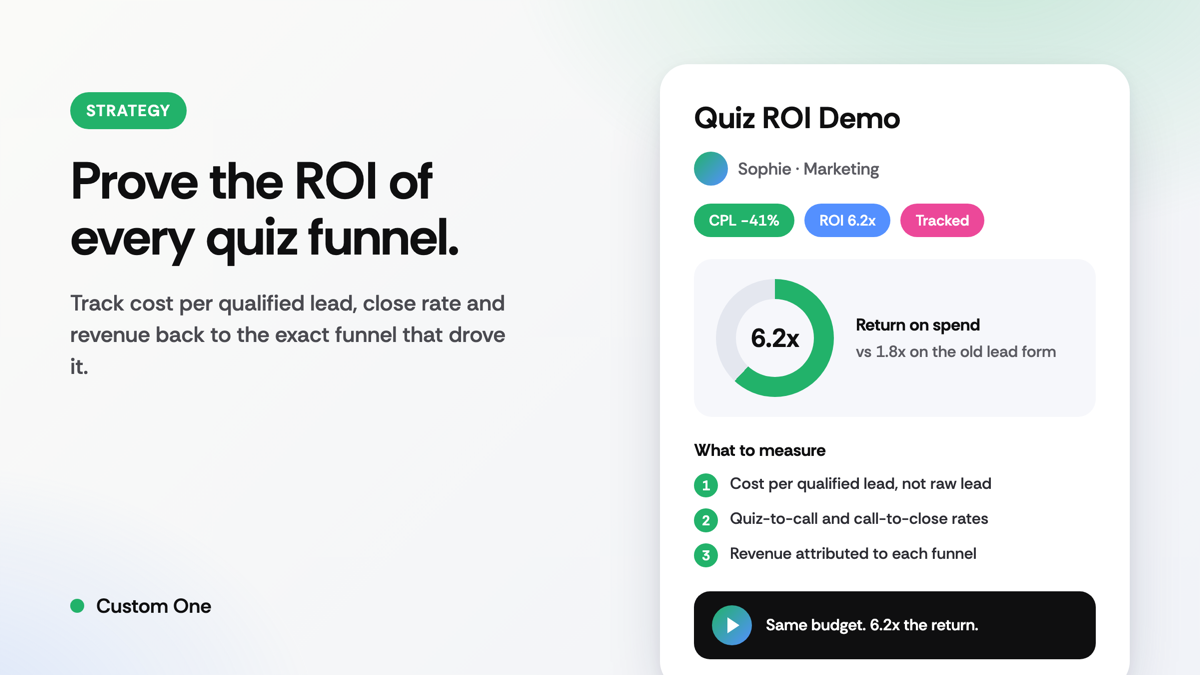
Clicks, completions, and raw lead counts tell you a funnel is busy. They don't tell you it's profitable. A quiz that collects 1,000 emails at $8 each looks impressive until you learn only 40 of those leads were a real fit and just three bought. ROI cuts through all of it by asking one question: for every dollar in, how many came back out?
The discipline of measuring ROI also changes how you build. Once you know exactly which segment converts and at what cost, you stop optimizing for completions and start optimizing for qualified, revenue-generating leads, which is the entire point of adding a quiz in the first place, as we argue in quiz funnel vs form.
The Five Core Metrics
You need exactly five numbers to understand a quiz funnel's economics. Track these and the full picture emerges.
- Cost per lead (CPL). Total spend ÷ total leads captured. Your headline efficiency number, but the most misleading on its own.
- Qualification rate. Qualified leads ÷ total completers. How well your questions and scoring filter for fit.
- Cost per qualified lead (CPQL). Total spend ÷ qualified leads. The metric that actually predicts profitability.
- Show-up / engagement rate. Of qualified leads, how many take the next step (book, watch, reply). The bridge from lead to revenue.
- Close rate & revenue. Of those who engage, how many buy, and at what value. The output ROI is built on.
Each metric isolates one stage, so when ROI drops you can see exactly where the leak is, bad traffic (CPL), weak questions (qualification rate), or a follow-up problem (show-up). For the show-up stage specifically, we go deep in how to increase show-up rate.
The Quiz Funnel ROI Formula
The formula itself is simple; the discipline is in attributing revenue correctly.
The formula
ROI (%) = (Revenue from funnel − Total funnel cost) ÷ Total funnel cost × 100
Total funnel cost is not just ad spend. Include tooling, any paid traffic, and a fair allocation of the time spent building and maintaining the funnel. Undercounting cost flatters your ROI and leads to bad scaling decisions.
Revenue from funnel must be attributed only to leads that came through the quiz, tracked over a full sales cycle. A deal that closes 40 days after someone took the quiz still belongs to the funnel. This is why patience matters: judging ROI after one week almost always understates it.
Worked example: spend $4,000 to acquire 500 completers; 150 qualify (30% qualification rate, $26.67 CPQL); 60 engage; 12 close at $1,200 average = $14,400 revenue. The quiz's scoring is what kept sales focused on the 150 that mattered rather than all 500, the routing mechanics we cover in lead scoring and segmentation.
Worked example result
260%
ROI = (14,400 − 4,000) ÷ 4,000 × 100, from $4,000 spend to $14,400 in attributed revenue.
Why Cost per Qualified Lead Wins
If you track only one metric daily, make it cost per qualified lead. Here's why CPL alone deceives: two funnels can both report a $8 CPL, but if one qualifies 35% of leads and the other only 10%, their real costs are $22.86 and $80 per qualified lead respectively. Same headline number, wildly different economics.
CPQL is also the metric a quiz funnel improves most dramatically. Because the quiz scores and filters before sales ever gets involved, the unqualified majority never inflates your cost base with wasted sales time. Driving CPQL down, without dropping volume of good leads, is the clearest sign the funnel is healthy. For traffic-side levers on this, see cost per lead with a quiz funnel.
Benchmarks to Compare Against
Numbers mean nothing without context. Use these ranges as directional benchmarks, adjusting for your price point and market.
- Qualification rate: 25–50% of completers. Below 25%, check traffic-offer fit or loosen overly strict scoring. Above 50%, your bar may be too low.
- Quiz completion rate: 60–85% of starters finish a well-built 5–8 question quiz.
- Show-up / engagement of qualified leads: 40–70%, far above the 20–30% typical of generic lead forms.
- Target ROI: a paid quiz funnel should clear 200%+ once the sales cycle completes; many high-ticket funnels run far higher.
Treat these as starting lines, not finish lines. Your own historical funnel is the best benchmark, the goal is steady improvement quarter over quarter, which is exactly what a well-instrumented quiz makes possible.
How to Improve ROI Over Time
Once you can measure ROI, improving it becomes systematic rather than guesswork. Attack the weakest stage first.
- Low qualification rate? Tighten your questions and scoring so the quiz filters harder, see quiz questions that qualify.
- High CPL? Fix traffic-offer alignment before touching the quiz; bad traffic can't be saved downstream.
- Good leads, low show-up? Strengthen the result page and follow-up. Personalized video at this stage lifts engagement the most, the architecture is in our ultimate guide to personalized video funnels.
- Engaged but not closing? The gap is in the offer or the sales conversation, not the funnel mechanics.
The compounding effect is real: a 30% lift in qualification rate and a 30% lift in show-up multiply, not add. Small, measured improvements at each stage stack into dramatically better ROI, which is only possible because you measured every stage in the first place.
Pro tip
Don't optimize every stage at once. Find your weakest metric, fix only that, and re-measure before touching anything else, isolated changes are the only way to know what actually moved ROI.
Frequently Asked Questions
What is the most important metric for quiz funnel ROI?
Cost per qualified lead (CPQL). Raw CPL can look great while hiding a pipeline full of unqualified prospects. CPQL divides total spend by leads that actually meet your bar, reflecting real efficiency. A quiz funnel typically lowers CPQL sharply because it scores and filters prospects before they reach sales.
How do you calculate quiz funnel ROI?
ROI = (revenue from the funnel − total funnel cost) ÷ total funnel cost × 100. Total cost includes ad spend, tooling, and time. Attribute revenue to leads that came through the quiz, tracked over a full sales cycle so deals closing weeks later are credited correctly.
What is a good qualification rate for a quiz funnel?
Typically 25–50% of completers, depending on how strict your scoring is. Very high suggests a loose bar; very low suggests your traffic or questions are misaligned with your offer. Aim for a rate that yields a manageable volume of genuinely good leads.
How long should I wait before judging quiz funnel ROI?
At least one full sales cycle plus a buffer. If deals close in 30 days, give the funnel 45–60 days before concluding, since early revenue understates true ROI. Track leading indicators like CPQL and show-up rate meanwhile, they predict the final number before revenue lands.