Table of Contents
Every lead generation page eventually faces the same decision: do you put a form in front of your visitor, or a quiz? It looks like a small UX choice. In reality, it is one of the highest-leverage decisions in your entire funnel, and the gap between the two options is far larger than most marketers expect.
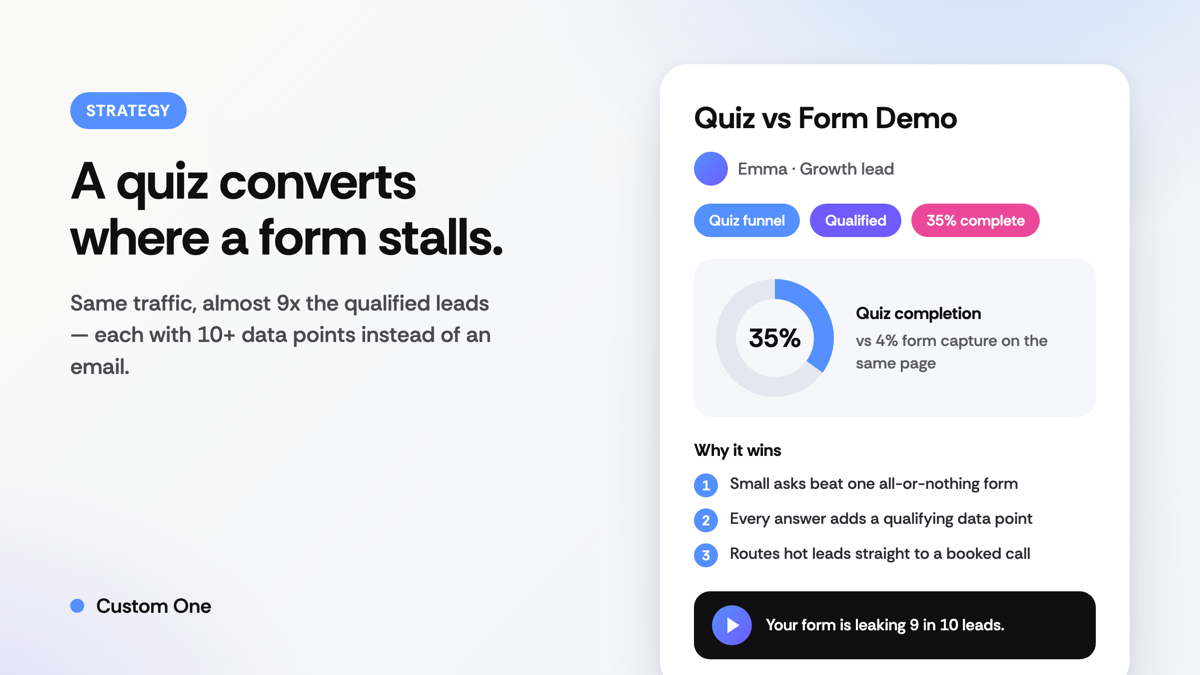
The short version: a standard lead capture form converts 2-5% of landing page visitors. A well-built quiz funnel converts 30-50% of the people who start it into completed, qualified leads. That is not a rounding error, it is a 5-10x difference from the same traffic. This article breaks down why that happens, where the numbers come from, and when you should still reach for a plain form instead. For the full methodology behind interactive funnels, our quiz funnel lead qualification guide is the pillar resource.
The Numbers: Form vs Quiz Conversion
Let us anchor the comparison in concrete figures before we explain the psychology.
The typical lead form
A classic “Get the guide” or “Request a demo” form asks for name and email, sometimes phone and company. Across industries, these forms convert somewhere between 2% and 5% of the visitors who land on the page. Add more fields and the rate drops further: every extra required field measurably reduces completion. The form is a single, all-or-nothing ask.
The quiz funnel
A quiz funnel replaces that single ask with a sequence of small, easy questions. Even though it collects far more information, completion rates among people who start the quiz routinely land between 30% and 50%. The reason is not magic, it is that the quiz changes the unit of commitment from “hand over all your details now” to “answer one quick question.”
The bottom-line gap
Imagine 1,000 visitors. A 4% form yields 40 leads. A 35% quiz yields 350 leads, and those 350 arrive with 10+ data points each instead of just an email. Same ad spend, same traffic, almost 9x the qualified pipeline. This is exactly the dynamic we explore in our breakdown of cost per lead with a quiz funnel, where more leads at higher quality drives the cost per qualified lead down dramatically.
Same traffic, the gap
40 vs 350
From 1,000 visitors, a 4% form captures 40 leads; a 35% quiz captures 350, each with 10+ data points instead of just an email. Almost 9x the qualified pipeline for the same ad spend.
Why Lead Forms Stall
To understand why quizzes win, you first have to understand why forms underperform. Three forces work against the traditional form.
The all-or-nothing ask
A form presents every field at once. The visitor sees the full cost of participation before receiving any value. Their brain runs a quick cost-benefit calculation, “Is this guide worth giving up my email and phone number?”, and very often the answer is no. There is no momentum, no progressive investment, just a wall of fields and a submit button.
No reward until the very end
With a form, the prospect gets nothing until they have given everything. There is no feeling of progress, no sense that the experience is responding to them. It is a transaction, and transactions invite resistance.
Generic by design
A form treats every visitor identically. The coach with a $50k course and the curious beginner fill out the same two fields and get the same follow-up. Because nothing about the experience adapts to the individual, there is no curiosity, no personalization promise, and no reason to lean in.
Why Quiz Funnels Win
A quiz funnel inverts every one of those weaknesses. It is engineered around how people actually make small decisions.
Micro-commitments build momentum
Each quiz question asks for one small, low-risk choice. Clicking “Coaching” vs “Agency” costs nothing. But once a prospect has answered three or four questions, the principle of commitment and consistency kicks in: they have started, so they want to finish. The contact details, the part a form leads with, come near the end, when the prospect is already invested.
The curiosity gap
A quiz promises a result: a score, a recommendation, a personalized assessment. From the first question, the prospect is working toward something they want to see. That curiosity gap pulls them forward through the questions in a way a static form never can. This is the same mechanism that lets quiz funnels lift show-up rates from 20% to 70%.
Progressive disclosure feels lighter
Showing one question per screen makes a 12-question quiz feel lighter than a 4-field form. The cognitive load at any moment is tiny. The prospect is never staring at the full cost of participation, only the next small step. The result is a paradox marketers find hard to believe until they test it: the longer experience often converts better.
Why the quiz wins
A form is one all-or-nothing ask with no reward until the end. A quiz swaps that for micro-commitments plus a curiosity gap: each easy answer builds momentum toward a result the prospect wants to see. The longer experience converts better precisely because it feels lighter.
Lead Quality, Not Just Quantity
The conversion gap is only half the story. The bigger advantage is what you know about each lead.
A form lead is an email and a name. You know nothing about their situation, budget, urgency, or fit. Your sales team starts every conversation from zero, and a large share of those conversations are with people who were never a fit in the first place.
A quiz lead arrives with 8-15 answers attached: their role, their main challenge, their goal, their budget range, their timeline. Before anyone picks up the phone, you already know who is worth a call and who should go into a nurture sequence. That is the core promise of quiz-based lead qualification, you are not just capturing more leads, you are capturing leads you can act on intelligently. To set the qualifying questions up inside the product, see our help guide on building quiz questions.
Segmentation happens automatically
Because every answer is structured data, you can route prospects automatically: high-budget, high-urgency leads to a sales call; lower-intent leads to a personalized video sequence; the wrong-fit leads to a polite off-ramp. A form gives you a single undifferentiated list. A quiz gives you a segmented, prioritized pipeline on day one.
When a Plain Form Still Wins
A quiz is not always the right tool. There are clear situations where a simple form is the better, faster choice.
- High-intent, single-action requests. If a visitor is already on your pricing page and clicks “Book a demo,” do not make them take a quiz. They have decided. A one-field form gets out of their way.
- Newsletter and content signups. When the only thing being exchanged is an email for a newsletter, a quiz adds friction with no payoff. Keep it to one field.
- Existing customers and warm lists. People who already know and trust you do not need the warming-up a quiz provides. A direct ask respects their time.
- Pure contact forms. “Send us a message” is a different job from lead generation. A quiz would feel out of place.
Quick rule
Use a form when the visitor already knows what they want and the action is low-friction (book a demo, newsletter signup, warm list). Use a quiz when you need to qualify, segment, or warm up colder traffic and can personalize the value you deliver from their answers.
The rule of thumb: use a form when the visitor already knows exactly what they want and the action is low-friction. Use a quiz when you need to qualify, segment, or warm up colder traffic, and when the value you deliver can be personalized based on the answers.
How to Switch From Form to Quiz
If your main acquisition page currently runs on a form, here is the migration path that consistently works.
1. Map your qualifying questions
List the things your sales team wishes they knew before the first call: role, main challenge, goal, budget, timeline. Each becomes a quiz question. Aim for 8-15 total. Our full walkthrough on how to create a quiz funnel that converts covers question design in depth.
2. Lead with the easiest questions
Open with low-risk, identity-based questions (“Which best describes you?”) and save anything that feels like work for later, once momentum is built. Put the email capture near the end, framed as “Where should we send your results?”
3. Promise a real result
The quiz must pay off. A score, a tailored recommendation, or, most powerfully, a personalized video that references the prospect's answers. This is where quiz funnels and personalized video combine into something a form can never replicate.
4. Route by answer
Set up your segmentation so each completed quiz triggers the right next step automatically. The investment pays off every single day your funnel runs.
Frequently Asked Questions
Does a quiz funnel really convert better than a form?
Yes, consistently. Standard lead capture forms convert at 2-5% of landing page visitors. Quiz funnels routinely convert 30-50% of the people who start them into completed, qualified leads. The reason is structural: a quiz lowers the perceived commitment of each step, builds momentum question by question, and promises a personalized result, while a form asks for everything upfront with no reward until the end.
Are quiz funnel leads lower quality than form leads?
No, the opposite is usually true. A form collects contact details with no context. A quiz collects 8-15 data points about the prospect's situation, goals, and budget before you ever talk to them. That means quiz leads arrive pre-segmented and pre-qualified, so your team spends time only on the prospects who fit, rather than dialing through a list of unknowns.
When should I still use a plain form instead of a quiz?
Plain forms still make sense for very low-friction actions where the visitor already knows what they want: a newsletter signup, a single-field demo request from a high-intent pricing page, or a simple contact form. A quiz funnel earns its place when you need to qualify, segment, or warm up colder traffic, and when the value you deliver can be personalized.
How long should a quiz funnel be compared to a form?
Counterintuitively, longer often converts better. A 2-field form and a 12-question quiz can produce wildly different results, with the longer quiz winning. The quiz feels lighter because each step asks for only one small thing and the prospect is rewarded with progress and, eventually, a personalized result. Aim for 8-15 questions: enough to qualify and segment without triggering fatigue.