Table of Contents
Most marketers treat a quiz as a lead magnet: collect the email, move on. That leaves the most valuable part of the quiz completely untapped. Every answer a prospect gives is a structured data point, and together those answers can power a scoring and segmentation system that decides, automatically, exactly how each lead should be handled.
Done well, this is the difference between a list of 350 anonymous emails and a prioritized pipeline where your hottest leads get a call within the hour and everyone else enters the right nurture track. This article is the practical, build-it-today guide to scoring and segmenting leads inside a quiz funnel. If you want the broader strategy first, start with our quiz funnel lead qualification guide.
Scoring vs Segmentation
These two terms are often used interchangeably, but they do different jobs and you want both.
Scoring answers one question: how qualified is this lead? It produces a single number. A prospect with a high budget, urgent timeline, and clear pain points scores high. A casual browser scores low. Scoring is one-dimensional and it is about intensity.
Segmentation answers a different question: what kind of lead is this? It produces a category, not a number. A coach and an agency might both score equally high, but they need completely different messaging and offers. Segmentation captures who they are and what they need.
The magic happens when you combine them. Scoring tells you how urgently to act; segmentation tells you what to say. A hot coach and a hot agency both deserve fast follow-up, but with different videos, different case studies, and different offers.
Building Your Scoring System
A scoring system is simpler than it sounds. You assign point values to answer options, then sum them at the end.
1. Pick your scoring dimensions
Most B2B and coaching funnels score on three to four dimensions: budget, urgency, fit, and authority. Each quiz question maps to one of these. “What is your monthly ad budget?” feeds budget. “When do you want to solve this?” feeds urgency. “What best describes your business?” feeds fit.
2. Assign points to each answer
Within a question, higher-value answers earn more points. For a budget question: under $1k = 1 point, $1-5k = 3 points, $5k+ = 5 points. The exact numbers matter less than the relative weighting. Keep it consistent so the final score is meaningful.
3. Weight the questions that matter most
Not every question is equally predictive. If budget is the single biggest determinant of whether someone buys, give budget answers a wider point spread (1 to 10) than a softer question (1 to 3). This weighting is where your knowledge of your own business turns into a smarter score. Inside Custom One, you configure all of this in the quiz questions editor, then map the totals into your result logic.
4. Test against known outcomes
Once live, compare scores to actual conversions. If your highest-scoring leads are not the ones who buy, adjust the weights. Scoring is a model, and models improve with feedback.
Defining Your Lead Tiers
Raw scores are not actionable on their own. You need thresholds that turn a number into a decision. Three tiers is the standard, reliable structure.
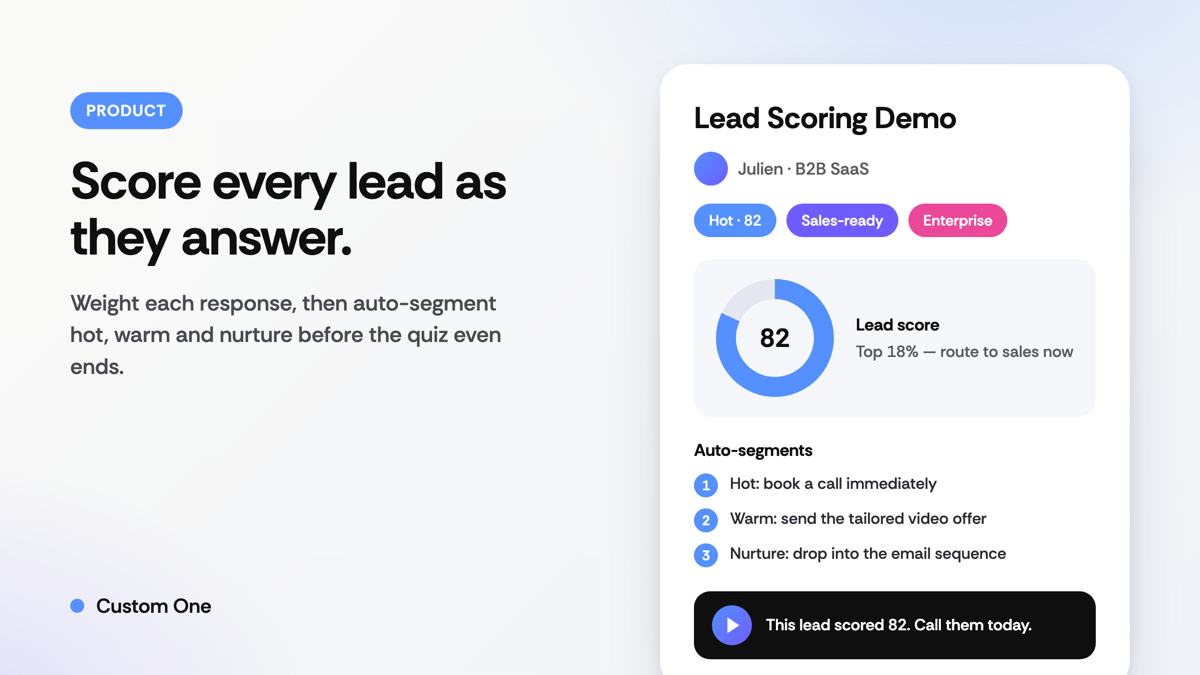
- Hot (top tier). Scores in the highest band. These are sales-ready: high budget, urgent, perfect fit. They should get the fastest, most personal follow-up you can offer, ideally a call or a tailored personalized video within minutes.
- Warm (middle tier). Genuine interest but a missing element, budget not confirmed, timeline further out, or unsure of fit. These leads need nurturing: a personalized video sequence that addresses their specific situation and moves them toward readiness.
- Cold (bottom tier). Low intent or poor fit. Rather than waste sales time, route them to an automated educational track. Some will warm up over time; the rest cost you nothing to keep nurturing.
Set the thresholds based on your score distribution, not on round numbers. If most leads cluster between 20 and 35 points, your “hot” cutoff should reflect where the genuinely strong leads actually fall. This tiering is the operational backbone of any high-performing quiz funnel.
Pro tip
Set your tier thresholds from where leads actually cluster, not from round numbers. Pull a sample of past scores, find the natural breaks, and draw your Hot/Warm/Cold cutoffs there. A threshold that ignores your real distribution mislabels good leads as cold.
Segmenting by Persona and Use Case
Scoring tells you how hot a lead is. Segmentation tells you who they are, and that determines the content of your follow-up.
Scoring vs segmentation
Scoring is one number: how qualified a lead is. Segmentation is a category: who the lead is. You need both. Scoring decides the speed and channel of follow-up; segmentation decides the message inside it.
The cleanest way to segment is with an early identity question: “Which best describes you?” with options like Coach, Agency, Course Creator, SaaS Founder. That single answer routes the prospect into a persona track, and every subsequent message can speak their language with their case studies and their objections.
Use-case segmentation works the same way. A prospect who says their main goal is “more booked calls” needs different proof than one who says “lower cost per lead.” Map each goal answer to a content track. This is exactly the kind of audience split we cover for specific verticals like coaches and trainers in our build guide on creating a quiz funnel that converts.
Keep segments operationally honest
Every segment you create is follow-up content you have to build and maintain. Three to five well-served segments beat ten half-baked ones. Start with the personas that represent the bulk of your revenue and expand only when each existing segment is genuinely differentiated.
Watch out
Every new segment is follow-up content you must build and keep current. Ten thin segments with generic messaging convert worse than three sharp ones. Add a segment only when you can write follow-up that genuinely differs from the rest.
Routing Each Segment Automatically
Scoring and segmentation are only valuable if they trigger action without manual effort. The routing layer is where the system earns its keep.
The logic is a simple matrix: tier (hot/warm/cold) on one axis, persona on the other. A hot coach goes to one path; a warm agency to another. In practice this means:
- Hot leads → immediate booking link plus a personalized video, and an internal alert so your team can follow up fast.
- Warm leads → a persona-specific personalized video sequence designed to close the gap that kept them out of the hot tier.
- Cold leads → an automated educational sequence with periodic re-qualification.
Because every prospect answered the quiz, the routing happens the moment they finish, no spreadsheet, no manual sorting. This immediacy is one of the reasons quiz funnels lift show-up and engagement rates so dramatically: the right message reaches the prospect at peak attention.
Personalizing the Follow-Up
The final step is where scoring and segmentation pay off most visibly: personalized content that references the prospect's own answers.
A generic follow-up says “Here are our services.” A scored, segmented follow-up says “Based on your answers, a coaching business spending $3k/month aiming to book more calls, here is exactly how we would approach it.” The second message converts dramatically better because it proves you were listening.
The most powerful version of this is personalized video. When the prospect's quiz answers drive which video segments they see, the experience feels one-to-one even at scale. Our ultimate guide to personalized video funnels covers how to architect that delivery layer on top of the scoring and segmentation you have just built.
Frequently Asked Questions
What is lead scoring in a quiz funnel?
Lead scoring means assigning point values to each answer so that, by the end of the quiz, every prospect carries a numeric score reflecting their fit and intent. High scores indicate hot, sales-ready leads; lower scores indicate prospects who need nurturing. The score drives what happens next: a call, a personalized video sequence, or an automated track.
How many segments should a quiz funnel have?
Three to five is the practical sweet spot. Fewer than three and you are not differentiating enough to justify the quiz. More than five and the work of building distinct follow-up for each segment outweighs the benefit. A common structure is hot, warm, and cold, optionally split by persona or use case.
What is the difference between scoring and segmentation?
Scoring is a single numeric measure of how qualified a lead is. Segmentation groups leads by who they are or what they need, persona, use case, or budget tier. Scoring tells you how hot a lead is; segmentation tells you which message fits them. A strong quiz funnel uses both at once.
Can I segment leads without a quiz?
You can, but it is far harder and less accurate. Without a quiz you guess from behavior signals or rely on sparse form data. A quiz collects explicit, structured answers directly from the prospect, making scoring and segmentation reliable from the very first interaction. To set those answers up, see the quiz questions editor guide.