Table of Contents
A quiz funnel is only as good as the questions inside it. You can have a beautiful design and a slick personalized result at the end, but if your questions do not surface who can buy, who is ready, and who is a fit, you are just collecting emails with extra steps.
This article is the question playbook. We will cover what actually makes a question qualifying, the framework to structure them, the four question types every funnel needs, and a bank of copy-able examples for the most common verticals. If you want the strategic context around all of this, start with our quiz funnel lead qualification guide.
What Makes a Question Qualifying
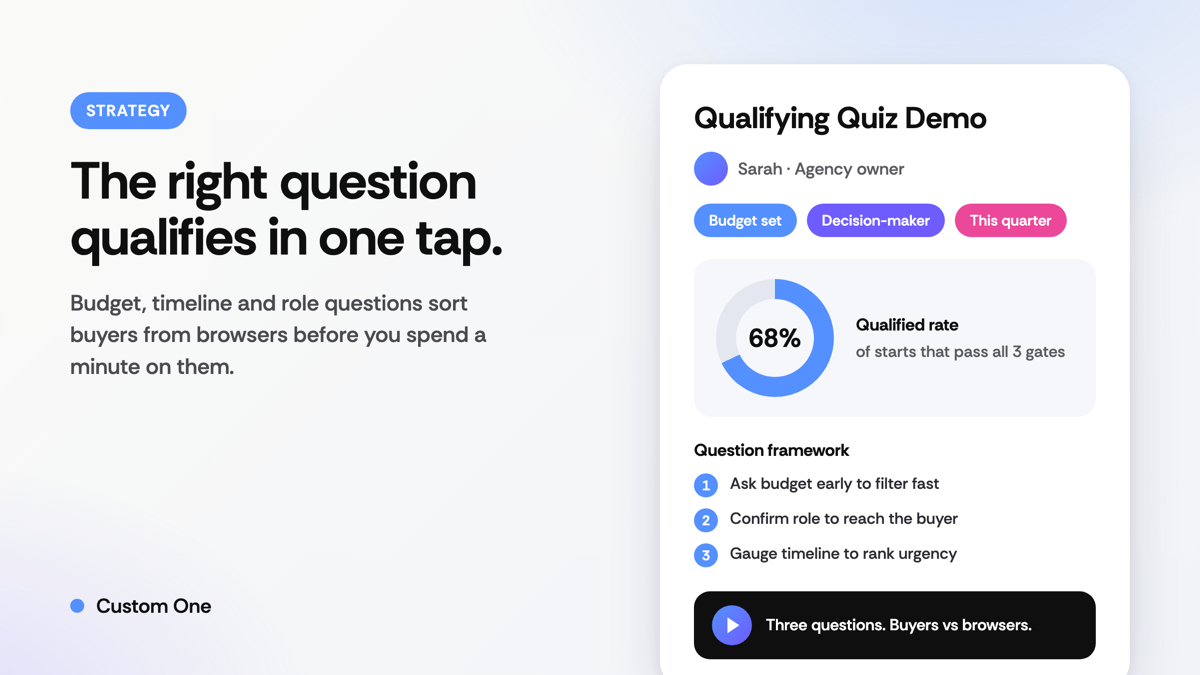
Not every question belongs in a quiz funnel. A qualifying question does at least one of three jobs: it scores the lead (feeds a numeric measure of fit), it segments the lead (assigns them to a persona or use case), or it personalizes the result they see. If a question does none of these, it is filler, and filler increases drop-off without improving your data.
The test is simple. For every question ask: what decision does this answer change? If a budget answer moves the lead between hot and cold tiers, it is doing real work. If a question is there because it “feels nice to know,” cut it. This discipline is what separates a high-performing funnel from a long, leaky one.
The BANT Framework for Quizzes
The most reliable structure for qualifying questions is BANT, Budget, Authority, Need, Timeline. It has been a sales-qualification standard for decades because those four signals genuinely predict whether a deal closes. Translated into a quiz, each dimension becomes one or two questions.
The BANT shortcut
Budget, Authority, Need, Timeline. Cover those four and you capture the signals that actually predict a close. For coach and creator offers, drop Authority and run a lighter Pain-Budget-Timeline variant since the prospect is usually the buyer.
- Budget. Can they afford the solution? Ask it as a current-spend range tied to the problem, not a blunt “what's your budget.”
- Authority. Are they the decision-maker? A single “what's your role” question handles this and doubles as segmentation.
- Need. How acute is the pain? Surface the problem and its impact so you can score urgency of need.
- Timeline. When do they want to solve it? “Now” scores high; “someday” scores low.
For coaches, creators and lower-ticket offers, a lighter pain-budget-timeline variant works well, authority matters less when the prospect is the buyer. Whichever variant you use, BANT ensures you never ship a quiz that looks engaging but fails to capture the signals that matter. Map each of these answers to points in your scoring model, exactly as we describe in the lead scoring and segmentation guide.
The Four Question Types You Need
Beyond the framework, every strong quiz uses a mix of four functional question types. Each plays a distinct role.
1. The identity question
“Which best describes you?” This is your segmentation anchor. The answer routes the prospect into a persona track that shapes every following message. Place it early so the rest of the quiz can adapt.
2. The pain question
“What's the biggest thing holding you back right now?” This surfaces need and lets you mirror the prospect's own language back to them in the result. It is also your highest-engagement question, because people love being understood.
3. The budget / commitment question
“How much are you currently investing to solve this each month?” This is your sharpest scoring lever. Frame it diagnostically and offer ranges that map cleanly onto your tiers. You build and weight these inside the quiz questions editor.
4. The timeline question
“When do you want this solved?” Urgency is one of the most predictive buying signals and one of the easiest to score. “This month” and “just exploring” should sit at opposite ends of your point scale.
Copy-able Examples by Vertical
Frameworks are abstract until you see the actual wording. Here are tested question sets you can adapt directly.
Coaches and consultants
- Identity: “Where are you in your business right now?”, Just starting / Growing / Scaling / Stuck.
- Pain: “What's the #1 thing slowing your growth?”, Not enough leads / Low show-up rate / Closing struggles / Pricing.
- Budget: “How much do you currently invest in growth each month?”, Under $500 / $500–2k / $2k–5k / $5k+.
- Timeline: “When do you want results?”, Now / Next quarter / Just exploring.
Agencies and service providers
- Identity: “What type of business do you run?”, Agency / Freelancer / In-house team.
- Authority: “Who decides on new tools?”, Me / Me + partner / A team.
- Pain: “Where do you lose the most clients?”, Lead gen / Onboarding / Retention.
- Budget: “Monthly ad/tool spend?”, Under $1k / $1–5k / $5k+.
SaaS and digital products
- Identity: “What's your role?”, Founder / Marketing / Sales / Ops.
- Need: “What are you trying to improve?”, Conversion / Activation / Retention.
- Timeline: “When are you evaluating a solution?”, This month / This quarter / Researching.
Notice how each set still maps back to BANT, only the wording changes to fit the audience. That adaptability is exactly what makes a quiz outperform a static form, a contrast we break down in quiz funnel vs form.
Question Order and Flow
The same questions in a different order produce very different completion rates. The proven sequence:
- Open easy. Lead with the identity or pain question, engaging, low-friction, builds momentum.
- Sensitive in the middle. Ask budget and authority once the prospect is invested. Effort already spent makes people more willing to answer.
- Contact last. Capture email at the end, after they have committed real effort and are primed for their personalized result.
This commitment curve is why quizzes convert so much higher than forms that demand everything up front. It is also why the result page matters so much: it is the payoff that justified all that effort. We cover building it well in how to create a quiz funnel that converts.
Pro tip
Order beats wording. Open with an easy identity or pain question, place budget and authority in the middle once the prospect is invested, and capture contact details last. The same questions reordered this way lift completion noticeably.
Mistakes That Kill Qualification
Even with the right framework, a few common errors quietly destroy qualification quality.
- Too many questions. Past eight, drop-off climbs faster than insight. Cut anything that doesn't score, segment, or personalize.
- Leading answers. If every option sounds equally good, you learn nothing. Make the ranges genuinely differentiate.
- Vague budget framing. “What's your budget?” gets dodged. “What are you investing now?” gets answered honestly.
- No scoring behind the answers. Pretty questions with no point values produce a quiz you can't act on. Wire every answer into your scoring and segmentation model.
Avoid these
Four errors quietly wreck qualification: too many questions (past eight, drop-off outpaces insight), options that all sound equally good, vague budget framing like “what's your budget,” and answers with no points behind them. Each one turns a quiz into pretty filler you can't act on.
Get the questions right and everything downstream, routing, personalized video, follow-up, gets dramatically easier, because the data feeding it is finally trustworthy.
Frequently Asked Questions
How many questions should a qualifying quiz have?
Five to eight is the sweet spot. Fewer rarely captures enough to score and segment reliably; more increases drop-off without adding qualifying signal. Every question should feed a score, a segment, or the personalization of the result, if it does neither, cut it.
What is the best framework for qualifying quiz questions?
BANT (Budget, Authority, Need, Timeline) is the most reliable starting point for B2B and high-ticket offers. For coaches and creators, a lighter pain-budget-timeline version works well. Whichever you choose, cover the dimensions that determine whether someone can and will buy, then wire them into your scoring model.
Should I ask budget directly in a quiz?
Yes, but frame it as a current-investment range tied to a goal rather than a blunt “what's your budget.” Asking “how much are you investing to solve this each month?” feels diagnostic, and the ranges you offer become your scoring tiers.
Where should the qualifying questions go in the quiz?
Open with an easy, engaging question, place sensitive qualifying questions (budget, authority) in the middle once the prospect is invested, and capture contact details at the end. You can arrange all of this in the quiz questions editor.